

Deriv vs Weltrade – Best Broker for Synthetic Indices (2025)
In 2025, Deriv and Weltrade are two well-known names for trading synthetic indices. Both brokers attract foreign traders seeking stable platforms, low spreads, and fast execution in the fiercely competitive world of synthetic assets.
Weltrade has established itself as a formidable rival, providing a variety of trading conditions and user-friendly platforms, while Deriv, a pioneer in the creation of synthetic indices such as Boom and Crash, continues to rule the market with its distinctive product line.
This article helps you choose the best broker for synthetic indices in 2025 by comparing Deriv and Weltrade based on important criteria including regulation, trading platforms, asset diversity, fees, deposit methods, and customer care.
Editor’s Review: Deriv vs Weltrade — Who Is 2025’s Leading Broker for Synthetic Indices?
Deriv continues to dominate the synthetic index market in 2025 thanks to its distinctive Boom & Crash, Volatility, and Range Break products, which are accessible around-the-clock and supported by several trading platforms and minimal spreads. However, Weltrade’s SyntX synthetic instruments, extremely low $1 entrance, and alluring incentives have drawn attention. Weltrade caters to novices wanting cheap and quick withdrawals, whereas Deriv is better for traders seeking depth, diversity, and dependability.
Pros & Cons: Deriv vs Weltrade
Deriv
- Unique synthetic indices (Boom & Crash, Volatility, Range Break)
- 24/7 trading availability
- Multiple platforms (DTrader, MT5, Deriv X, cTrader)
- Tight spreads, transparent pricing
- No deposit bonuses
- Non-EU entities lack compensation scheme
Weltrade
- SyntX synthetic instruments
- Low $1 minimum deposit
- Attractive bonuses & promotions
- Fast withdrawals (often within 30 minutes)
- Offshore regulation only (IFSC Belize)
- Bonus withdrawals tied to trading conditions
Understanding the Synthetics of Deriv and Weltrade
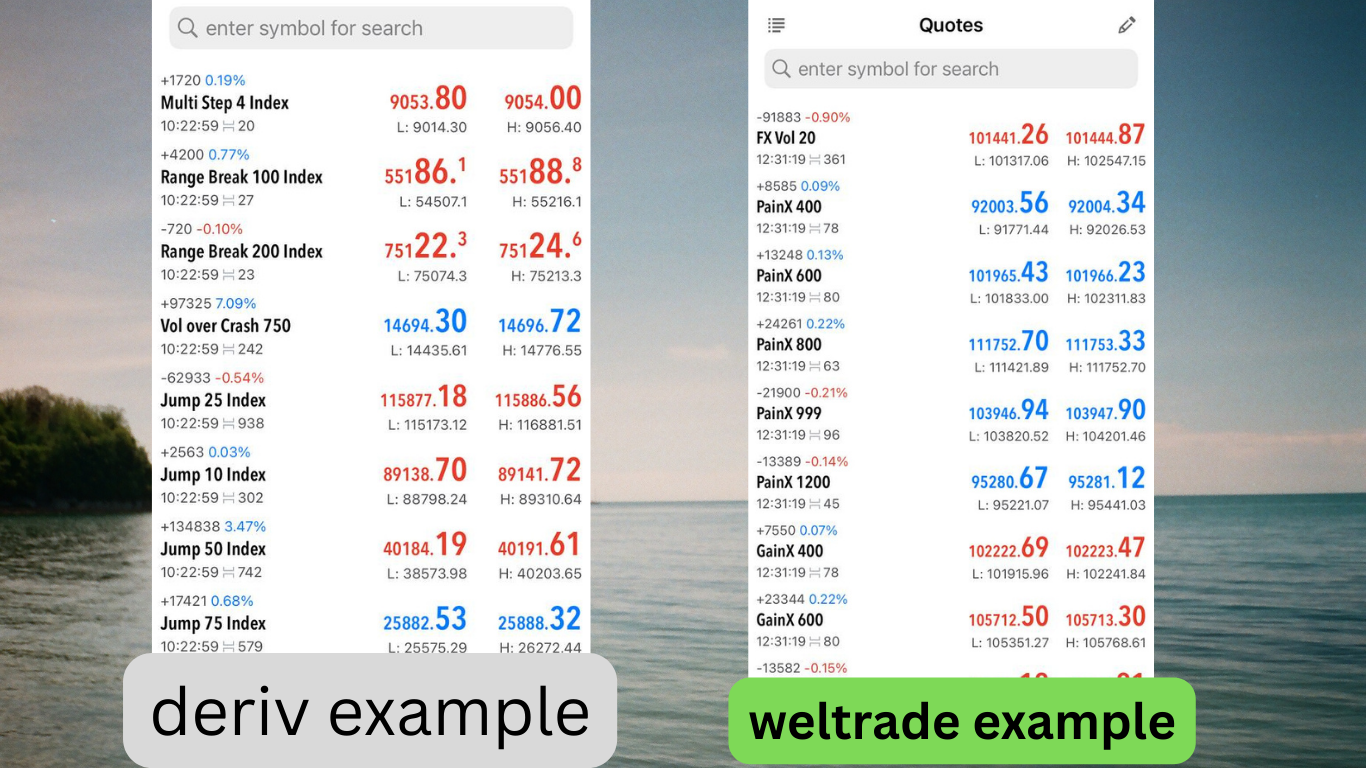
Both brokers provide synthetic instruments that are powered by computers instead of actual asset order flow around-the-clock. You may compare like-for-like by reading the brief description and samples of Weltrade’s SyntX and Deriv’s synthetics below.
What Are Weltrade Synthetics?
The synthetic indices produced by sophisticated algorithms that mimic the behavior of financial markets are known as Weltrade’s SyntX products. Instead of being linked to actual assets, you are trading price fluctuations that are manufactured by algorithms. These instruments are available around-the-clock, have high leverage and low spreads, and are built for consistent volatility, which makes them perfect for short-term trading and technique testing.
Well-known SyntX Examples
- FX Vol. For traders who want to practice steady execution and steer clear of abrupt swings, this model simulates a market with constant, predictable volatility, much like forex.
- SFX Vol. Enhances the FX Vol idea with simulated “news bursts,” creating sporadic, large price jumps to evaluate reaction-based tactics.
- PainX / GainX
- PainX usually trends downwards with some steep dips.
- GainX trends upwards with occasional significant increases.
- FlipX Each tick has a 50/50 probability of rising or falling. Because traders may select step sizes such as “1,” “1–2,” or “1–2–3,” this is a pure volatility-play tool.
- SwitchX After every leap, it switches between PainX and GainX modes, generating a regular sequence of slow movements and sudden spikes that makes tactical timing essential.
- BreakX Only changes how it behaves when the price surpasses the peak (last leap). Excellent for testing breakout strategies.
- TrendX It may be used for trend-following strategies as it can identify the direction of new trends by examining recent leaps and changing modes to correspond with either bullish or bearish momentum.
Advanced Variants & Leverage
- Pain X 400 / Gain X 400 — 400% leverage (0.01 pip → 4-point move)
- Pain X 600 / Gain X 600 — 600% leverage (0.01 pip → 6-point move)
- Pain X 800 / Gain X 800 — 800% leverage (0.01 pip → 8-point move)
- Pain X 999 / Gain X 999 — 999% leverage (0.01 pip → 9.99-point move)
- Pain X 1200 — Maximum leverage at 1200% (0.01 pip → 12-point move)
Note: High-leverage variations are very volatile and designed for experienced traders.
What Are Deriv Synthetics?
The proprietary, algorithm-driven markets that make up Deriv’s synthetic indexes are intended to mimic various volatility regimes and behaviors. They are accessible on several platforms (DTrader, MT5, Deriv X, and cTrader) and trade around the clock. To accommodate a variety of tactics, the catalog includes spike-based, trend, breakout, and jump-style instruments.
Popular Deriv Examples
- Boom & Crash (e.g., Boom 500/1000, Crash 500/1000) — abrupt “spike” occurrences that occur at stochastic intervals are a defining feature of trend instruments.
- Volatility Indices (V10/V25/V50/V75/V100 + 1s variants) — For high-frequency methods, 1-second indices tick once per second to replicate various, set volatility levels.
- Range Break (RB100/RB200) — Perfect for breakout systems, the price consolidates in ranges before breaking out after building up pressure.
- Jump Indices (Jump 10/25/50/75/100) — random “jumps” occur every N ticks; useful for testing jump-aware entries/stops.
Notes on Trading
- Available 24/7 with tight, transparent spreads.
- Multiple platforms with charting and automation options (e.g., MT5 EAs).
- Varied behaviors allow backtesting of trend, mean-reversion, breakout, and HFT-style tactics.
Deriv vs Weltrade: Which Suits You?
Deriv is best for
- Traders seeking diversity and depth in trading (Boom & Crash, Volatility, Range Break, Jump).
- Those who want precise, transparent pricing in synthetic markets that are open around the clock.
- Traders who appreciate using several platforms such as DTrader, MT5, Deriv X, cTrader.
- Intermediate-to-advanced traders using HFT-style, breakout, and trend methods.
- Traders who favor a more open pricing structure and no bonus lock-ins.
Tip: Great for systematic backtesting across fixed-volatility indices.
Weltrade is best for
- Beginners and those trading small accounts, the minimum deposit is $1.
- Traders who want to trade SyntX instruments like PainX/GainX, FlipX, SwitchX, TrendX.
- Traders who want classic MT4/MT5 with EA support and simple setup.
- Those who like promotions/bonuses (note: withdrawal conditions apply).
- High-risk individuals who prefer high-leverage options (experienced traders only).
Note: Always read bonus terms and understand leverage risks before funding.
Trading Platforms — Deriv vs Weltrade
Deriv platforms: Deriv provides you with 24/7 access to patented synthetics (Boom & Crash, Volatility, Range Break, Jump) through DTrader (web), Deriv MT5, Deriv X, and cTrader. With free demo accounts to test strategies, these platforms include extensive charting/indicators, tight spreads, quick execution, and automation using MT5 EAs and DBot. You receive good risk tools (SL/TP, pending orders, negative balance protection on the EU business) on desktop and mobile devices, and setup is easy and minimum deposits are modest.
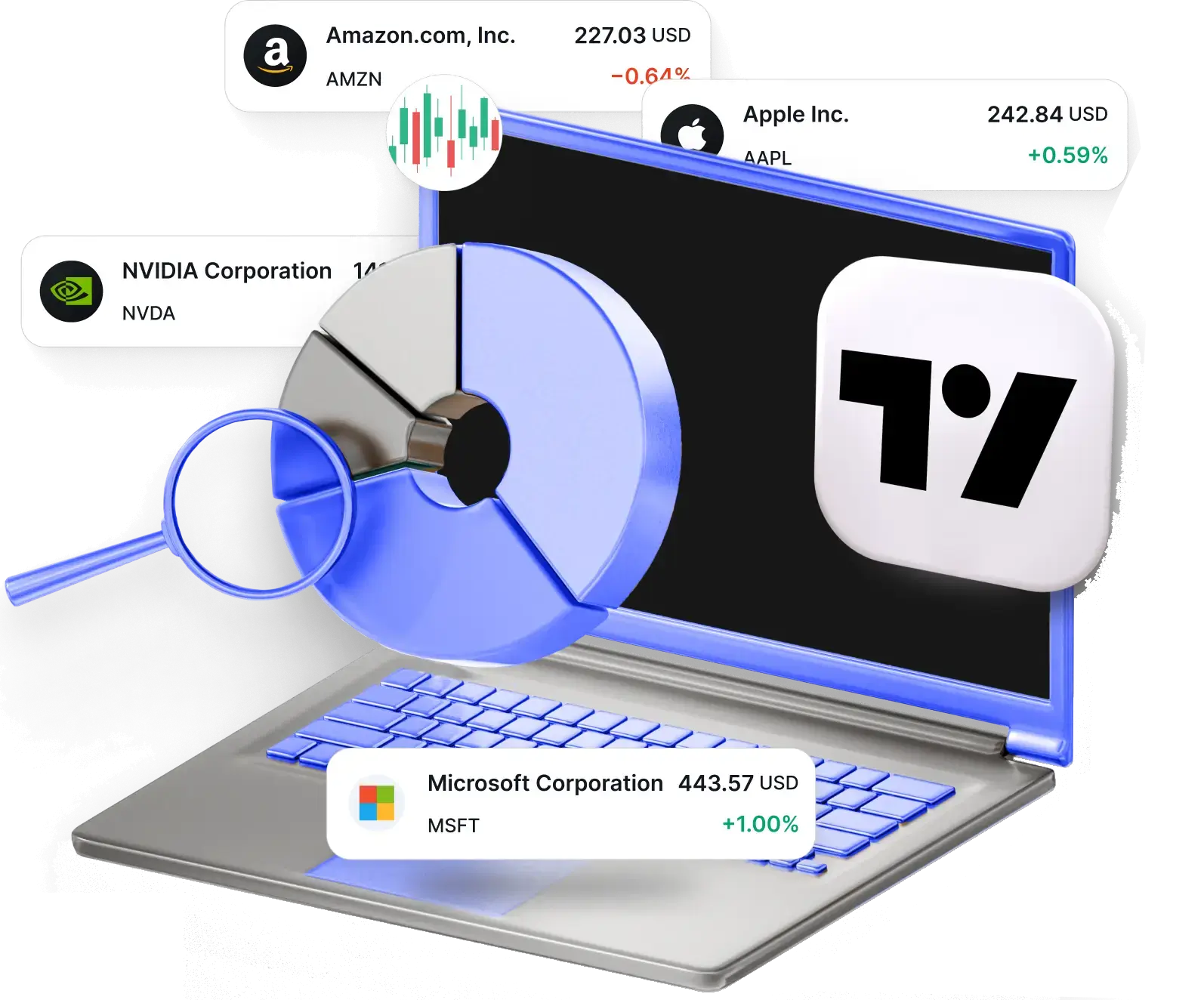
Weltrade platforms: Weltrade provides MT4, MT5, and TradingView either on desktop, online, or on mobile with FX/CFDs and SyntX synthetic indices available around-the-clock. A $1 minimum deposit is required for active accounts, and you may establish a free sample to test methods. The systems provide a clear, mobile-friendly interface together with EA automation, extensive charting and indicators, numerous order types (market, pending, SL/TP), and quick execution.
Deposits, Withdrawals & Trading Fees
Deriv: offers support for bank choices, e-wallets, cards, and cryptocurrency (availability varies by entity/region). Low minimum deposits and speedy processing are normal; withdrawal timeframes vary by method and KYC. The most common trading expenses are spreads and overnight financing; the majority of synthetic indices do not charge commissions. Although there are often no deposit costs from Deriv, there may be network or processing fees as well as currency conversion charges.
Weltrade: Offers cards, e-wallets, local payment methods, bank transfers, and crypto (varies by region). Live accounts start from $1; deposits are usually instant, while withdrawals depend on method and verification. Fees center on spreads (and commissions on some account types). Promotions/bonuses are available but have trading/withdrawal conditions. Payment processor and FX conversion fees may apply.
| Broker | Deposit Methods | Withdrawal Methods |
|---|---|---|
| Deriv | Cards E-wallets Bank transfer Crypto | E-wallets Bank transfer Crypto Cards* |
| Weltrade | Cards E-wallets Local payments Bank transfer Crypto | E-wallets Bank transfer Crypto Cards* |
*Availability varies by entity/region and payment processor. Fees and limits may apply.
Customer Support — Deriv vs Weltrade
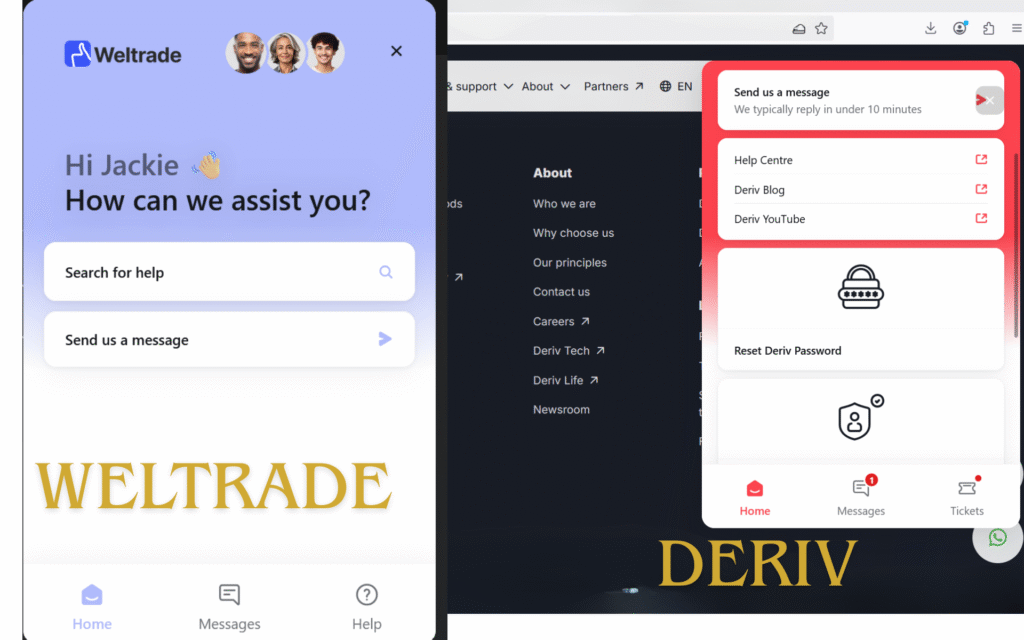
Deriv support:A useful self-serve Help Center (including instructions on platform usage, deposits and withdrawals, and verification) can be reached via email,whatsapp and live chat. During busy trading hours, response times are often fast, with multilingual coverage and straightforward status updates for frequent problems. Account-based assistance is offered for platform issues, funding, and KYC.
Weltrade support: Live chat, email, and a knowledge base focused on SyntX and MT4/MT5 setup. Onboarding is assisted with step-by-step articles, and support can guide you through deposits, withdrawals, and EA configuration. Response times vary by region/time zone, with regular announcements for promos and service notices.
Mini FAQ — Deriv vs Weltrade
Which broker is better for synthetic indices in 2025?
Deriv wins on depth and variety (Boom & Crash, Volatility, Range Break, Jump) with multiple platforms and 24/7 markets. Weltrade stands out for SyntX, the $1 minimum, and frequent promos—good for beginners and small accounts.
What platforms do they support, and can I use a demo?
Deriv: DTrader (web), Deriv MT5, Deriv X, cTrader — free demo available. Weltrade: MT4 & MT5 (desktop/web/mobile) and TradingView access — free demo available.
How do deposits/withdrawals and fees compare?
Deriv: low minimums; cards, e-wallets, bank, crypto; costs mainly spreads + swaps (most synthetics commission-free). Weltrade: from $1; cards, e-wallets, local methods, bank, crypto; spreads (and commissions on some accounts). Processing times and availability vary by region/entity.
Conclusion — Our Pick for 2025
Both brokers are strong: Weltrade shines with its $1 minimum, MT4/MT5/TradingView access, and SyntX lineup; great for beginners and promo hunters. Our overall pick is Deriv for its depth and reliability—unique synthetics (Boom & Crash, Volatility, Range Break, Jump), multiple platforms, 24/7 markets, and transparent pricing. Choose Deriv if you want breadth and consistency; pick Weltrade if you value ultra-low entry and bonuses.